Saudi Culture Attestation is one of the most important verification procedures for Pakistani degree holders who intend to work, obtain professional registration, or sponsor family members in the Kingdom of Saudi Arabia. Before Saudi authorities can accept educational documents, the Saudi Cultural Mission must verify that a recognized institution has issued the degree and that the academic qualifications meet Saudi Arabian requirements.
Many applicants believe that HEC attestation and MOFA attestation are sufficient. However, for numerous professions in Saudi Arabia, especially engineers, teachers, doctors, healthcare professionals, and other skilled workers, Saudi Culture verification is a mandatory step before Saudi Embassy attestation can be completed.
The Saudi Cultural Mission conducts an independent verification process through universities and educational institutions. This verification ensures that submitted academic documents are authentic, issued by recognized institutions, and comply with Saudi educational standards.
Failure to meet Saudi Culture requirements can result in application delays, rejection of documents, visa complications, or inability to obtain professional registration in Saudi Arabia. Therefore, understanding the complete process before submission is essential.
Why Does Saudi Culture Verify Regular Classes?
Saudi Arabia has strengthened its educational verification procedures to ensure that foreign professionals entering the Kingdom possess genuine and properly earned qualifications. Educational verification helps employers, professional councils, government authorities, and licensing bodies assess the academic background of applicants before granting employment approvals, professional registrations, or visa benefits.
The Saudi Cultural Mission may communicate directly with the university’s Registrar’s Office, Controller of Examinations, Academic Affairs Department, or Degree Verification Cell to confirm:
- Whether the student was officially enrolled.
- Whether the degree was completed through regular studies.
- Whether examinations were conducted according to university regulations.
- Whether the degree and transcript are authentic.
- Whether the qualification meets university standards.
- Whether relevant educational authorities recognize the institution.
NOT ACCEPTABLE DEGREES FOR SAUDI CULTURE ATTESTATION
The following qualifications may require additional review during Saudi Culture verification:
- Distance Learning Degrees
- Virtual Learning Programs
- Correspondence Courses
- Private Candidate Degrees
- External Degree Programs
- Unrecognized Academic Programs
- Incomplete Academic Hierarchy Cases
Applicants should ensure that all educational records are accurate and that supporting documents are available before applying for Saudi Culture Attestation.
Universities and and Their Reasons of Unauthenticated
Saudi Culture verification is primarily designed for qualifications obtained through regular classroom-based education. Degrees completed through distance learning, virtual learning, private candidate, or external study modes may face rejection or additional scrutiny during the verification process.
Virtual University Degrees
Virtual University degrees are generally not accepted because the institution is commonly categorized as a distance learning university. Since Saudi Culture prefers qualifications earned through regular classes with verifiable attendance records, Virtual University graduates may face difficulties during verification.
Distance Learning Degrees
Degrees completed through distance learning programs may not qualify for Saudi Culture verification because regular classroom attendance cannot always be verified by the university.
Private Candidate and External Degrees
Qualifications obtained as a private candidate or through external examination systems may face verification challenges because attendance records and regular student status are often unavailable.
Affiliated College Degrees
Some degrees obtained through affiliated colleges may require additional verification. Acceptance depends upon the university’s response, availability of academic records, and compliance with Saudi Culture requirements.
AIOU Degrees
Certain degrees from Allama Iqbal Open University (AIOU) may have a chance of verification if the applicant can provide an official Regular Student Certificate, Bonafide Certificate, and verifiable attendance records. However, approval is not guaranteed and depends upon the university’s verification response and current Saudi Culture policies.
Important Note
Applicants holding degrees from AIOU, Punjab University, University of Karachi, Virtual University, or other institutions offering distance learning, private, or external study programs should confirm their eligibility before starting the Saudi Culture Attestation process. It can help avoid unnecessary expenses, delays, and disappointment during verification.
Checklist before starting the Saudi Culture verification process
Following is the checklist. You can say preliminary requirements
- Your Name and Father Name must be the same as per the CNIC on the Passport, degree, and Transcript
- Degrees must be attested from HEC and MOFA first. Online verification of HEC must work. Check your HEC verification by clicking here.
- If there is a spelling mistake in the name and the father’s name in the degree, transcript, CNIC, and passport. Get them corrected first. No ifs and buts
- You must have a Pakistani NICOP / CNIC and a passport to get a Pakistani degree attested by the Saudi culture. Both CNIC and passports must be valid before starting the verification Process
- We don’t do Saudi culture attestation for Pakistani nationals’ foreign degrees or Pakistani degrees for foreign nationals. People contacting us for the Saudi Culture process must have a Pakistani CNIC / NICOP and degrees issued by Pakistani Universities
- You must submit a university verification Fee voucher to your university in Pakistan before starting the degree verification process.
- In the case of a married female with the husband’s name mentioned on the CNIC and the wife’s and father’s names mentioned on the degree and transcript, the union council issued the Marriage Certificate must be provided.
- If you are already working in Saudi Arabia and you have a valid digital iqama, the verification process will be easy.
- If you have a job offer letter duly signed from the Saudi MOFA and issued by the Saudi Chamber of commerce, it will help.
Why Your Bachelor’s Degree Must Be Verified Before Master’s Degree Attestation
One of the most important requirements of Saudi Culture Attestation is the verification of your complete academic hierarchy. If you are applying for the attestation of a Master’s degree, you cannot skip the verification of your Bachelor’s degree. The Saudi Cultural Mission requires proof that a previously verified lower qualification supports every higher qualification.
For example, if you hold a Master’s degree, the Saudi Culture Mission will first verify your Bachelor’s degree before processing your Master’s degree. Similarly, applicants holding MPhil or PhD qualifications may be required to verify all previous academic qualifications in sequence.
Why Does Saudi Culture Follow This Rule?
The Saudi Cultural Mission verifies educational credentials to ensure that academic progression is genuine and follows recognized educational standards. Since a Master’s degree is obtained after completing a Bachelor’s degree, Saudi authorities must first confirm the authenticity of the Bachelor’s qualification before approving the higher degree.
This process helps verify:
- Academic hierarchy and progression
- Authenticity of educational qualifications
- University records and graduation history
- Compliance with Saudi educational requirements
The process cannot Be Run in Parallel.
Many applicants ask whether they can submit both Bachelor’s and Master’s degrees simultaneously to save time. In most cases, the answer is no.
The Saudi Culture verification process follows a sequential approach:
- Bachelor’s Degree Verification
- Bachelor’s Degree Approval
- Master’s Degree Verification
- Master’s Degree Approval
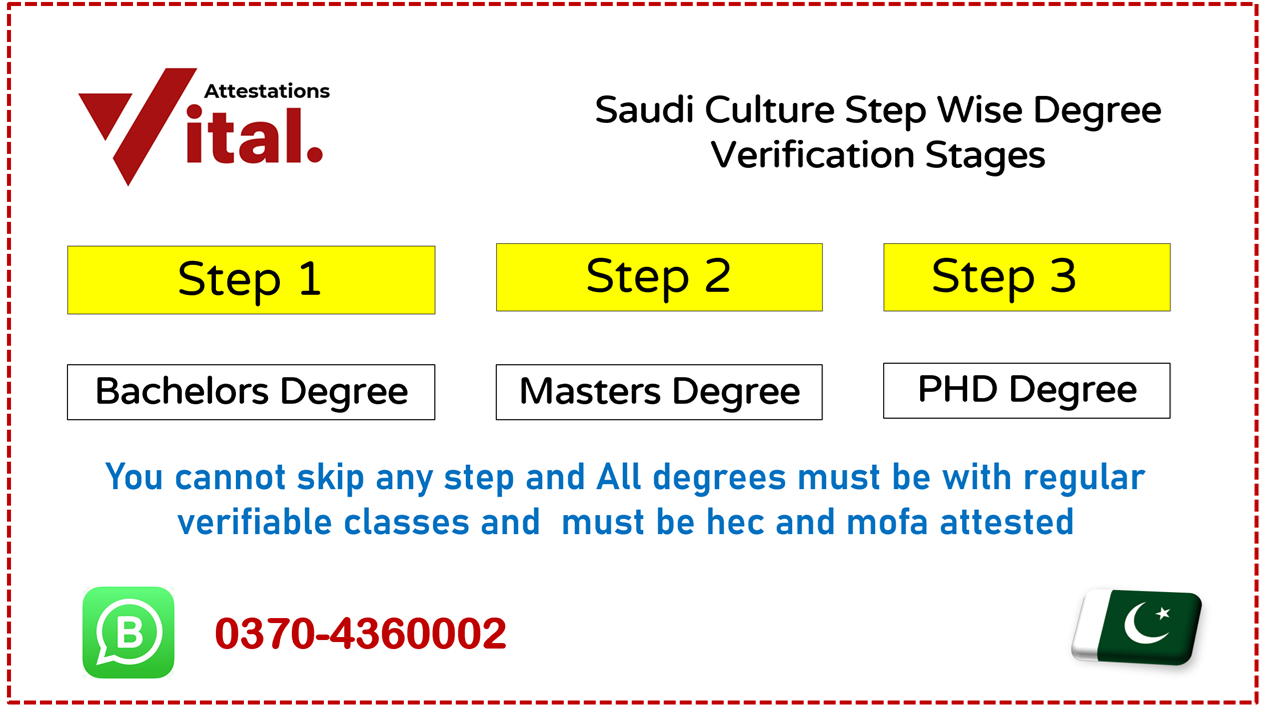
The next qualification is generally processed only after the previous qualification has been successfully verified.
Separate Cost and Processing Time
Applicants should also understand that each qualification involves its own verification process, processing time, and associated costs.
For example:
- Bachelor’s Degree Verification Fee
- Master’s Degree Verification Fee
- Separate University Verification Charges (if applicable)
- Separate Processing Time for Each Qualification
As a result, applicants holding multiple degrees should plan accordingly and start the verification process well before their intended travel or employment date.
Important Tip
If you intend to use a Master’s, MPhil, or PhD degree in Saudi Arabia, it is advisable to prepare all previous academic qualifications in advance. Ensuring that your Bachelor’s degree is properly attested and ready for verification can significantly reduce delays during the Saudi Culture Attestation process.
Requirements for Scanned Documents and Hard Copy Documents
Before starting the Saudi Culture Attestation process, applicants must prepare clear, scanned PDF copies of all required documents. Submitting complete and properly scanned documents helps avoid delays during university verification and Saudi Culture processing.
Scanned PDF Documents Required
Please prepare separate PDF files for each of the following documents:
- CNIC / NICOP (Front and Back)
- Passport Front Page (For Bachelor’s Degree Applicants)
- Complete Passport Copy – All 36 Pages in One PDF File (For Master’s, MPhil, and PhD Applicants)
- HEC Attested Bachelor’s Degree (Front and Back)
- Final Consolidated Transcript (HEC verification not required)
- University Verification Fee Voucher
- Job Offer Letter (If Available)
- Digital Iqama Copy (If Available)
Important Note About Transcripts
HEC attestation on transcripts is generally not mandatory. However, the transcript must be clear, complete, and issued by the university.
Additional Requirement for PhD Applicants
Applicants applying for a PhD degree verification must also provide:
- Complete PhD Thesis in PDF Format
Saudi authorities may require the thesis during the academic verification process.
Hard Copy Documents Required
Keep the following original documents available, as they may be required during processing:
- Original Degree
- Original Transcript
These documents are required for the second stage of attestation. Once the Saudi culture online verifies the degree, Hard copies must be submitted to the Saudi embassy in Islamabad for manual verification.
Important Points Before Submission
Keep Copies of All Expired Passports
Applicants should keep scanned copies of the front page of all previously issued passports.
In some cases, the Saudi Cultural Mission may request old passport records to verify travel history, identity records, or academic information. If an old passport is required and the applicant cannot provide it, the verification process may be delayed or rejected.
Ensure All Documents Are Clear and Readable
Poor-quality scans are one of the most common causes of processing delays. Before submission, make sure:
- All scans are in color.
- Text is clearly readable.
- No corners or pages are cut off.
- PDF files open correctly.
- All pages are included in the correct order.
Use Separate PDF Files
Each document should be scanned and saved as a separate PDF file unless specifically instructed otherwise. It helps Saudi Culture and university verification departments review documents more efficiently.
Client Responsibilities
There are basically two responsibilities on the client side.
- University Verification Fee Voucher Submission. Most universities charge a verification fee before responding to Saudi Culture verification requests. The client must deposit the fee voucher at the main campus bank of the respective university. After payment, a scanned PDF copy of the paid voucher should be shared with us for processing.
- University Follow-Up During Verification: When the Saudi Culture online portal sends a verification email to the university, ensuring a timely response from the university is the client’s responsibility. This communication takes place directly between the university and the Saudi portal and cannot be monitored by us.
If you are outside Pakistan, arrange for a blood relative or trusted friend to visit the university and follow up with the concerned department to ensure the verification email is answered promptly.
Saudi Culture Attestation Fee
The Saudi Culture attestation fee is 85,000 PKR, which covers all necessary expenses, including service charges for using the Saudi Culture online portal and Saudi embassy cost too.
Cost Breakup 60000 for Saudi culture and 25000 for embassy
This fee is a comprehensive cost required to verify and authenticate your academic documents for employment or higher education opportunities in Saudi Arabia.
Fee is non Refundable
Why Fees Are Non-Refundable
All fees paid for Saudi Culture Attestation are non-refundable because the verification process starts immediately after document submission. Various organizations become involved in the process, including universities, verification departments, courier services, and the Saudi Culture online portal.
Even if a degree is rejected, delayed, or the university does not respond to the verification request, the verification work and related expenses have already been incurred.
Non-refundable costs may include:
- University Verification Fees
- Saudi Culture Processing Fees
- Courier Charges
- Document Handling Charges
- Administrative Processing Costs
Applicants are therefore advised to carefully review all requirements and document eligibility before starting the Saudi Culture Attestation process.
Please note that payment of fees does not guarantee approval, as the final decision depends upon the university’s verification response and Saudi Culture requirements.
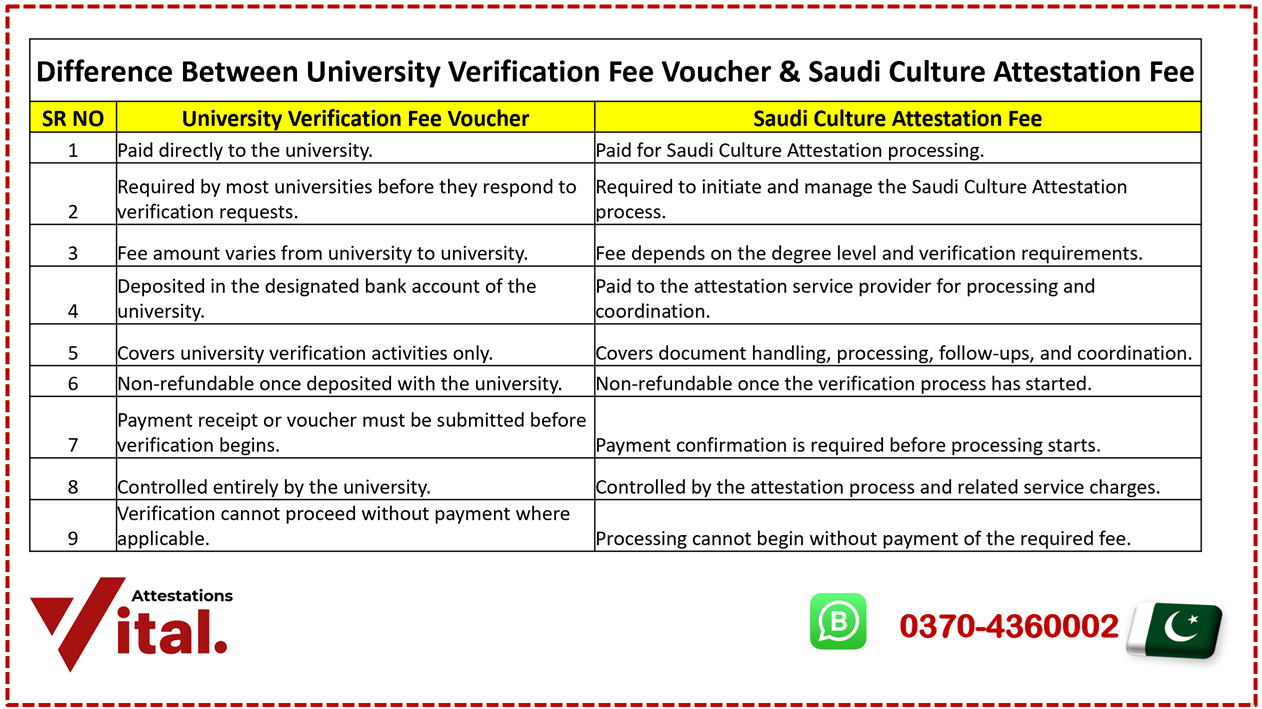
Difference of University verification Fee and Over all Fee
Different universities charge verification fees, which are required when the university is contacted via email. The reply will get delayed if the verification fee is not paid before starting the process of Saudi culture attestation. Some of the university fees are mentioned below for your reference.
univeristy verification charges
- Punjab University takes 8000 RS per degree fee voucher
- AIOU takes 100 US dollar fee vouchers. Convert them into Pakistani rupees at the time of submission
- UET Lahore, Taxila, and Peshawar take 2500 PKR charges
- The range is 2000 to 6000 in Superior, Faisalabad University, BZU Multan, and Comsats, etc.
- LUMs, GIK does not take any verification fee. They reply to emails for free.
Contact us on whatsapp to get more guidance on this
Overall charges are different from the university verification fee. It includes
- Online portal non-refundable charges
- Service charges
- Saudi embassy charges
- courier charges
- document handling charges
- profit
Saudi Culture Attestation Time
The Saudi Culture attestation time typically depends on the following factors:
- Response Time from Educational Institutions: The Saudi Cultural Office requires confirmation from the issuing university or educational institution to verify the degree. Delays in receiving this confirmation can extend the processing time.
- Document Preparation: If your documents (degree, transcript) are already attested by the Higher Education Commission degree attestation and the MOFA Pakistan degree attestation, this can speed up the process.
- The volume of Applications: The time may also vary based on the workload at the Saudi Cultural Office or the online portal.
Estimated Timeframe:
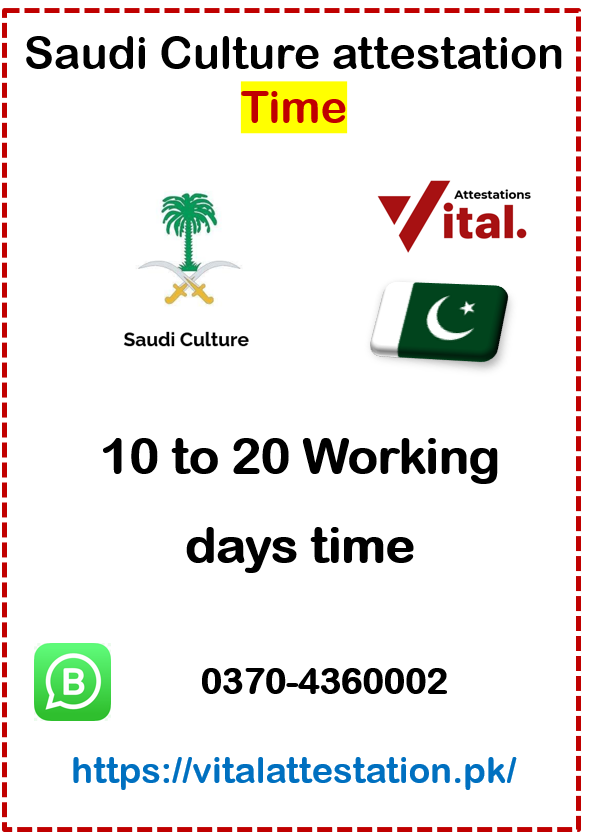
The process can take anywhere between 2 to 6 weeks, depending on the efficiency of the document verification and the responsiveness of your educational institution.
For urgent requirements, professional attestation services like Vital Attestation can assist in expediting the process by ensuring that all documentation is complete and submitted correctly.
Universities with delayed responses to email reply
Three universities delay the response to the email. If your degree is from one of the following universities, you must follow up actively to process the reply. It accounts for 95 % delay reasons.
- Punjab University – Lahore
- University of Karachi – Karachi
- Allama Iqbal Open University – Islamabad
Reasons
- Big and old universities have sub-campuses and affiliated colleges all across Pakistan.
- Old school methodology, systems not online, a diary number at each process
- Too much workload on email reply
- Old-age employees.
- Manual internal university verifications.
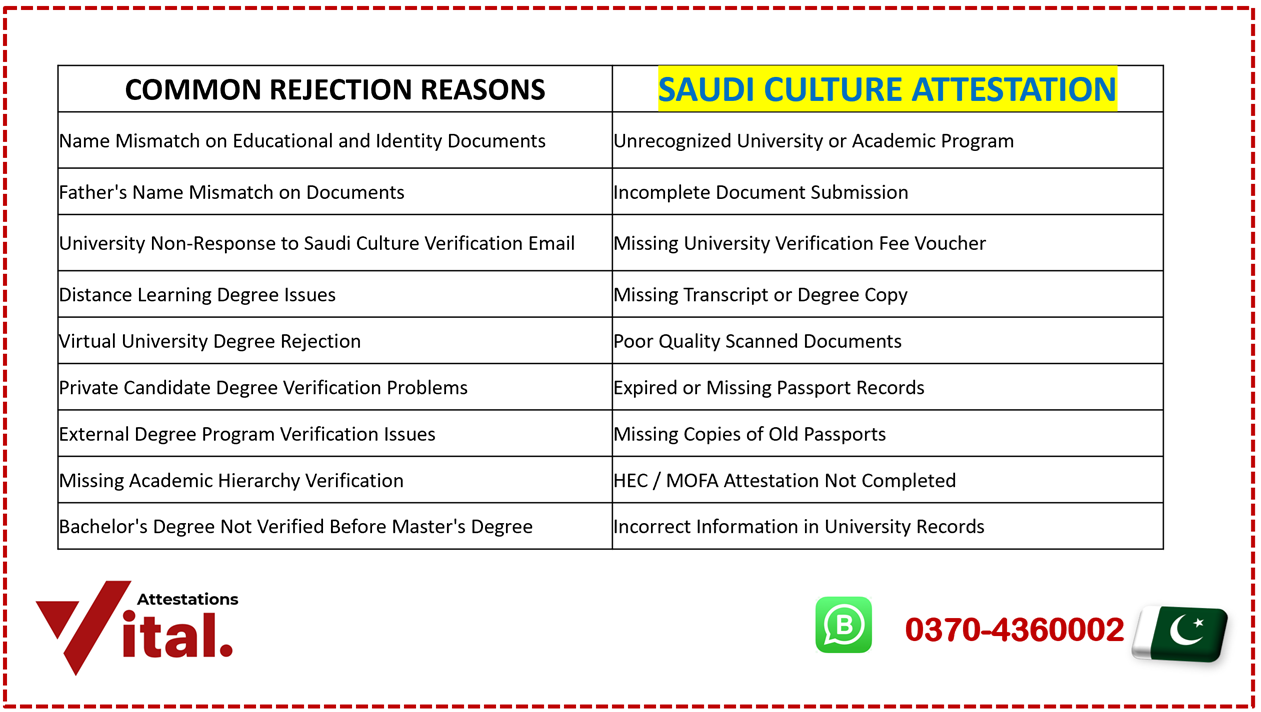
Common Rejection Reasons for Saudi Culture Attestation
Saudi Culture Attestation can be delayed or rejected for several reasons. Understanding these common issues before applying can save considerable time, effort, and expense.
- Name Mismatch on Documents: One of the most common reasons for rejection is a mismatch between the applicant’s name on the CNIC, Passport, Degree, or Transcript. Even minor spelling differences can create verification issues.
- Father’s Name Mismatch: If the father’s name appears differently across educational and identity documents, Saudi Culture may request clarification or reject the application until the discrepancy is resolved.
- University Does Not Respond to Verification Email: Saudi Culture relies on direct verification from the university. If the university fails to respond to verification emails or delays its response, the application may remain pending or be rejected.
- Distance Learning or Virtual Degree: Degrees obtained through distance learning, virtual learning, private candidate, or external study programs may face rejection because Saudi Culture generally prefers regular classroom-based education.
- Missing Academic Hierarchy: Applicants seeking verification of a Master’s, MPhil, or PhD degree may be required to verify previous qualifications as well. Missing Bachelor’s or Master’s degree records can cause rejection or delays.
- Unrecognized University or Program: Degrees issued by institutions or academic programs that cannot be properly verified may not qualify for Saudi Culture approval.
- Incomplete Documents: Missing transcripts, verification vouchers, passport copies, or other required documents can prevent the verification process from moving forward.
- Poor Quality Scanned Documents: Blurred scans, missing pages, cropped documents, or unreadable PDFs may result in objections or rejection during document review.
- HEC or MOFA Attestation Not Completed: Educational documents generally require prior attestation from HEC and MOFA before Saudi Culture verification can begin.
- Inability to Provide Old Passport Records: In some cases, Saudi Culture may request copies of previously issued passports. If the applicant cannot provide the required passport records, verification may be delayed or rejected.
- Incorrect Information in University Records: Differences in date of birth, registration number, degree title, or personal information within university records can create verification problems.
- Fake or Altered Documents: Any document found to be forged, altered, tampered with, or inconsistent with university records will be rejected immediately.
Important Note
Most Saudi Culture rejections occur because of incomplete documentation, university verification issues, or academic eligibility concerns. Applicants should carefully review all requirements before submitting documents to minimize the risk of rejection.
Why Choose Vital Attestation Services for Saudi Culture Attestation?
Saudi Culture Attestation is one of the most complex educational verification procedures for Saudi Arabia. The process involves universities, HEC, MOFA, Saudi Culture verification, and continuous follow-up with multiple departments. A small mistake can result in delays, additional costs, or rejection of the application.
Specialized Experience in Saudi Culture Cases
Vital Attestation Services has extensive experience handling Saudi Culture Attestation cases for employment visa holders, engineers, doctors, teachers, IT professionals, and family visa applicants.
Guidance Before Submission
Our team reviews your documents before processing to identify potential issues such as name mismatches, missing documents, academic hierarchy concerns, or university verification requirements.
Regular Case Updates
Clients receive timely updates regarding the progress of their Saudi Culture verification process, helping them stay informed at every stage.
University Verification Support
We guide clients regarding university verification requirements, fee vouchers, documentation, and follow-up procedures to help avoid unnecessary delays.
Nationwide Service
Whether you are located in Islamabad, Rawalpindi, Lahore, Karachi, Peshawar, Quetta, or overseas, our team can assist you throughout the Saudi Culture Attestation process.
Transparent Process
We clearly explain the required documents, expected processing time, fees, and verification requirements before starting the case.
Professional Document Handling
Your documents are reviewed carefully to ensure they meet Saudi Culture, HEC, and MOFA requirements before submission.
Dedicated Customer Support
Our support team remains available to answer questions and provide assistance throughout the verification process.
Time-Saving Solution
Instead of dealing with multiple departments and procedures yourself, Vital Attestation Services helps streamline the process and reduce avoidable delays.
Trusted Attestation Partner
Our goal is to make the Saudi Culture Attestation process simple, transparent, and efficient while providing professional support from start to finish.
FAQS
Is Saudi Culture Attestation Mandatory?
Yes. Saudi Culture Attestation is mandatory for many educational qualifications that will be used for employment, professional registration, or other official purposes in Saudi Arabia. The Saudi Cultural Mission verifies the authenticity of academic credentials before they can proceed with further processing.
Can I Apply Myself?
Yes. Applicants can apply themselves and manage the verification process directly. However, Saudi Culture Attestation involves university verification, HEC attestation, MOFA attestation, document preparation, and continuous follow-up with multiple departments. Many applicants choose professional assistance to avoid delays and procedural mistakes.
Can Virtual University Degrees Be Attested?
Virtual University degrees generally face difficulties during Saudi Culture verification because the university is commonly categorized as a distance learning institution. Acceptance depends upon current Saudi Culture policies and verification requirements at the time of processing.
Can Private Degrees Be Accepted?
Private candidate, external, and distance learning degrees may face additional scrutiny during verification. Acceptance depends upon the university’s verification response, availability of attendance records, and Saudi Culture requirements applicable at the time of processing.
Is HEC Attestation Mandatory?
Yes. Educational documents must generally be attested by the Higher Education Commission (HEC) before they can be submitted for Saudi Culture verification.
Is MOFA Attestation Mandatory?
Yes. After HEC attestation, documents usually require attestation from the Ministry of Foreign Affairs (MOFA), Pakistan, before the Saudi Culture processing can begin.
How Long Does Saudi Culture Attestation Take?
Processing time varies depending on the university’s response time, degree type, and verification requirements. In most cases, the process may take between 10 and 20 working days after successful university verification. Delays can occur if the university does not respond promptly.
Can I Verify My Master’s Degree Only?
No. If you are applying for a Master’s degree verification, the Bachelor’s degree must generally be verified first. Saudi Culture follows an academic hierarchy verification process and may not process a higher qualification without verification of the preceding degree.
What Happens If the University Does Not Reply?
University response is one of the most critical parts of Saudi Culture verification. If the university does not respond to the verification email sent by the Saudi Culture online portal, the case may remain pending or be rejected. Applicants should follow up with their university and ensure that the concerned department responds promptly.
What Is a University Verification Fee Voucher?
Many universities charge a verification fee before responding to Saudi Culture verification requests. The fee voucher must be deposited according to university instructions and submitted before verification can proceed.
Is a Job Offer Letter Required?
A Job Offer Letter is not mandatory in every case. However, if available, it may support the verification process and help establish the purpose of attestation.
Can I Apply Without an Iqama?
Yes. Applicants who are applying for employment in Saudi Arabia for the first time can usually proceed without an Iqama. Existing Saudi residents may be asked to provide a digital Iqama if available.
Why Are Saudi Culture Fees Non-Refundable?
Fees are non-refundable because verification activities, document review, university coordination, administrative processing, and related expenses begin immediately after submission.
What Are the Most Common Rejection Reasons?
Common rejection reasons include name mismatches, university non-response, incomplete documents, distance learning qualifications, missing academic hierarchy, poor quality scans, and unverifiable university records.
How Can I Avoid Rejection?
Ensure that your name matches on all documents, complete HEC and MOFA attestation, provide all required documents, submit university verification fees, and actively follow up with your university regarding verification emails.
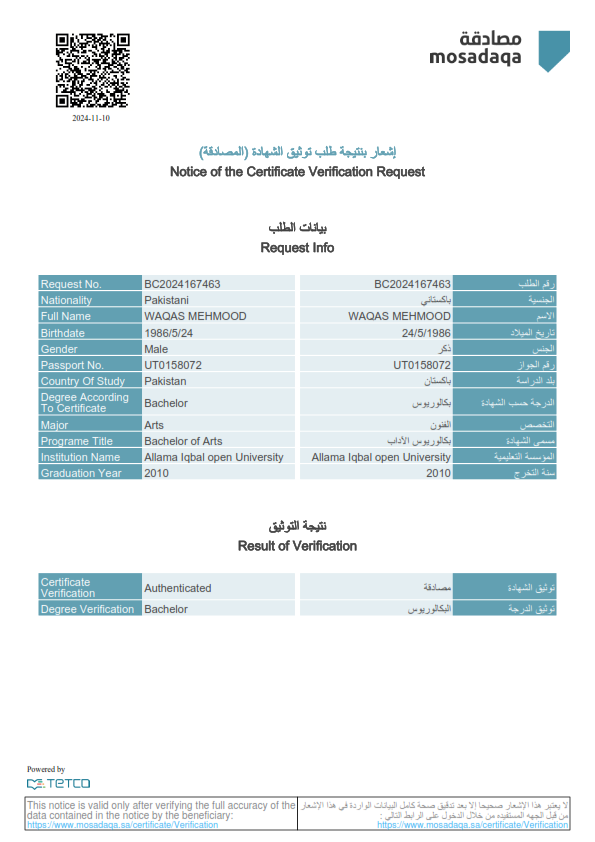
Attestation Sample
Contact Us
Lahore Office
Vital Attestation
(Rahman Rashid) C/O Foundry Co working
6TH floor Reception, Chohan tower, Near OMC hospital
Jail Rd, Shadman 1 Shadman, Lahore, 54030
0370 4360002
*NOTE* Use only TCS (Mehfooz Express) as Courier Service inside Pakistan and DHL if sending documents outside Pakistan.
Share tracking receipt after doing courier
Viisit our Lahore office by clicking here
CONTACT US VIA EMAIL
attestationservicespakistan@gmail.com
Reviews


aitazaz tahir
2 years ago
Good services.Highly recommended trusted person

Waqas Mehmood
2 years ago
I recently used Vital Attestation Services for the attestation of my academic documents, and I am extremely satisfied with their professionalism and support. They successfully attested the following degrees for me:
B.A (2-year program) from Open University
Master's (2-year program) from Virtual University
Master of Sciences in Computer Sciences (2-year program) from University of Engineering and Technology, Taxila
When my Virtual University degree was initially rejected for attestation, the team at Vital Attestation Services provided me with an alternative option, MOFA Apostille, which was accepted and ultimately enabled my visa process to move forward smoothly.
Their dedication, problem-solving approach, and exceptional customer service made the entire process stress-free and efficient. I highly recommend their services to anyone seeking reliable and professional attestation assistance!
B.A (2-year program) from Open University
Master's (2-year program) from Virtual University
Master of Sciences in Computer Sciences (2-year program) from University of Engineering and Technology, Taxila
When my Virtual University degree was initially rejected for attestation, the team at Vital Attestation Services provided me with an alternative option, MOFA Apostille, which was accepted and ultimately enabled my visa process to move forward smoothly.
Their dedication, problem-solving approach, and exceptional customer service made the entire process stress-free and efficient. I highly recommend their services to anyone seeking reliable and professional attestation assistance!

Discover Devices
2 years ago

Faiza Usman
2 years ago
Work on time with so much responsibility.. thankyou for helping me

shakoor hussain
2 years ago

saad alamgir
2 years ago
I have recently used vital to attest a few documents for me from Pakistan. Their service is great and very convenient where I only had to send them documents on WhatsApp and they delivered the attested documents to my place. I highly recommend them to everyone!!

Saad Turk
2 years ago
Very good experience with the professional and dedicated team of vital attestation.

Husnain Munir
2 years ago
Very good service for saudi embassy attestation

AL MANKAB BUILDING
2 years ago
Vital Attestation provides reliable and efficient services for Saudi cultural and embassy document attestation. Their expertise ensures accurate processing of educational, marriage, and other certificates. With a customer focused approach and clear communication, they make the complex attestation process smooth and hassle free. Recommended!

kashif malik
2 years ago
I had a very nice experience,All the process of verification of my degree
Was timely completed.
Was timely completed.

